Help grow our Universal Metadata Model
Summary: Dmytro Lugovyi, Dmytro Lugovyi, shared a comprehensive generic metadata model covering various aspects of data governance, inviting contributions from others to enhance it with suggestions and real examples. Grant Rollerson, Grant Rollerson, provided detailed feedback on the model's components and suggested changes, like removing Measure due to redundancy. Guanyi Zhong and Arielle Rolland added thoughts on contextual associations and the importance of an access management model, respectively. Stephan Awiszus, Stephan Awiszus, and others also offered insights on improving business asset coherence. Numerous suggestions were discussed, such as adding a Data Product and considering data profiling within data quality management, showing a collaborative effort to refine the model.
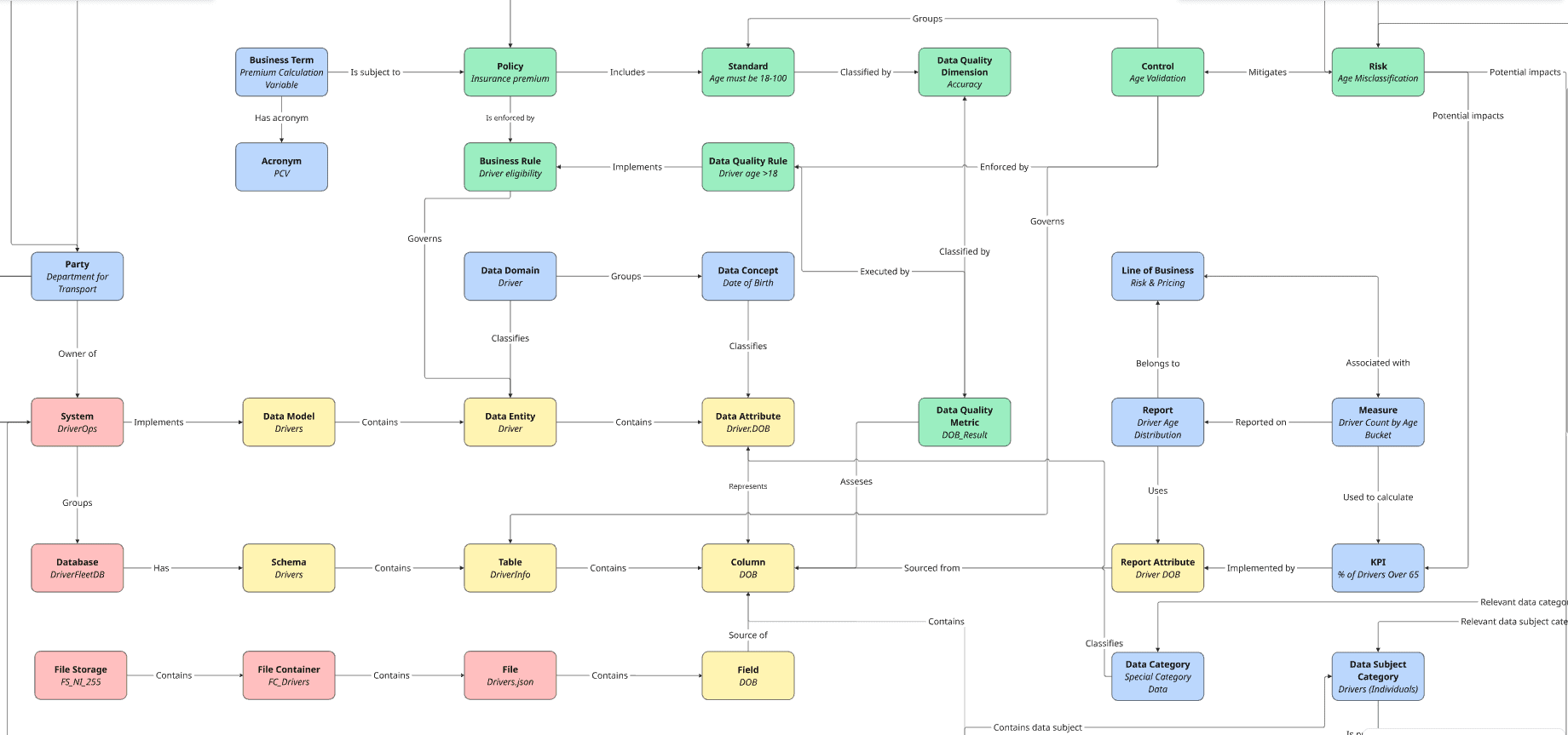
I’d like to share an example of the generic (universal) metadata model.
It covers policy, standards, data sets, APIs, DQ, reports, sharing, privacy, and more. And I hope it will help in your data governance journey.
I would also like to ask your help in turning this into a living best practice.
How to contribute
Suggest what asset types or relations are missing
There is no goal to connect everything with everything, so suggest only critical relations
Share real examples from your org. that would help to inspire other Data Citizens
And of course, don't hesitate to share your opinion about others’ ideas. We are all learning here.
Links
Miro board with the WHOLE DIAGRAM and free access to everyone: https://miro.com/app/board/uXjVJT7Rdzw=/
Password: Collibra2025
Jump in. Build with us. 🙌

jjelistratovs
·1 year ago · EditedNo Data Product ?:) ahah needs a bit of an update.
I've been recently looking at Data Product documentation and found out that there is no relationship between data product and data set, but I assume both are part of shopping/data marketplace experience. Would be interesting to learn more about this rationale, because in a lot of companies purchasable Data Sets are lower grade Data Product (lower certification level) and it's a natural progression to enrich and certify data set to data product level through maturity framework.
Data product documentation for the reference - https://productresources.collibra.com/docs/collibra/latest/Content/Assets/DataProducts/co_data-product.htm
Dmytro Lugovyi
OP11 months ago · Edited@jjelistratovs the data product is on the diagram, still with the Input / Output ports separately. I'll merge them soon.
Regarding the Data Sets, it's a good point. There are a lot of debates still about:
should Data Products be a business or data asset? Where is the line between Data Products and Data Asset?
can we call our Reports a Data Products if they are governed?
very interesting - Data as a Product vs Data Products
lifecycle of the Data Products and ownership is another topic...
I think it will take a couple of more years for the market to agree on the concept and all the processes around it
Arielle Rolland
·1 year ago · EditedHi Dmytro, good morning,
I was thinking about this model and I was wondering whether data profiling entity would be a good one to add as part of the data quality management 'domain'? Any thoughts?
Dmytro Lugovyi
OP1 year ago · Edited@Arielle Rolland we do have a "data category" asset type, can we reuse it or "data profiling" should be separate?
Anna Kovaleva
·1 year ago · EditedNice to see it. I was drawing it myself to get that visibility.
However, relations between Asset Types today are strongly depend on the presence of Asset Type within specific Domain type.
Therefore for the out-of-the-box Operating model - first what is needed is to define which asset types belong to which Domain types. Then build relations.
For me currently missing relations would be:
Measure (or its subtype KPI) - [measures] - Business Process.
Measure (or its subtype KPI) - [has] - Acronym
out-of-the-box offered operating model is such that Measure and Acronym do not belong to the same Domain type => thus, it is impossible to have such relation without changing a list of Asset types for specific Domain type.
Measure (or its subtype KPI) - [has] - Synonym
Anna Kovaleva
·1 year ago · Editeda while later just found the proof that other users of Collibra had to add the same relation between KPI/Measure and the Report (or Power BI report): https://community.collibra.com/forum/linkto/1a784d3a-de5c-45d9-9129-8eadffc0a6fc?focus_post=15290
Dmytro Lugovyi
OP1 year ago · Edited@annakovaleva Thank you for the feedback.
Currently, we have KPI in the model, linked to Report, Report Attribute, and Risk. Have you seen companies implement both KPI and Measure, and connected them to the Report?
Synonym - added
Acronym - I have one, connected to Party asset type
Stephan Awiszus
·1 year ago · EditedMost blue business assets stand at the beginning of our data governance journey similar to conceptual models, which summarize the high level data requirements. I think the model requires more coherence and integration of these business assets representing the business context, that is to be data driven.
Until today the "classifies" relation between conceptual and logical layer seem to be driven by the Colibra data classification tool, which isn't mandatory. I believe a more "universal" relation name could help to smooth the discussion with stakeholders and the implementation of the Collibra OOTB.
I am missing the consideration of https://www.collibra.com/blog/the-secret-to-trusted-ai-it-s-your-semantic-layer , which suggests a reposition of Business Term within the Universal Meta Data Model due to its significance for AI governance.
Dmytro Lugovyi
OP1 year ago@Stephan Awiszus thanks for sharing ideas. I totally agree, classification is not mandatory but I think it helps to connect pieces together for the privacy "use cases".
Business terms can be connected pretty much to every asset type on the model, so to be honest I didn't know which asset we should put there. I added "Driver" business term, since the whole model is about them.
Does it make sense?
Arielle Rolland
·1 year agoAnother feedback is that I have also been looking at modelling the Access Management and the Ownership model. I would find it relevant to also have Access Control List which is linked to the Employee Attributes (e.g. country, department, ..) and also the Data Role that the employee is playing (e.g. data owner, data steward, ..) which would help when looking at making the ownership visible and also help with supporting access request approval process.
Dmytro Lugovyi
OP1 year ago@Arielle Rolland thank you for the feedback. I added ACL (Access Control List) and Access Policy to the model.
Roles and responsibilities are critical part of the data governance but I think it will be too much if we start adding them here. Also they can be completely different depends on the type of the operating model you're going to implement - centralised, decentralised, federated or hybrid.
Arielle Rolland
·1 year agoA very good initiative, so thank you! It would be great to also have definition alongside each concept!
Nuriia Rose
·1 year agoWhere should Data Product belong on the model? Thanks for sharing!
Dmytro Lugovyi
OP1 year ago · Edited@Nuriia Rose The full diagram with data products, business processes and many other asset types is available on the link shared in the post. It's Miro diagram, which is a free app for everyone. You just need to register.
Please let me know if you have any issues with the access.
Guanyi Zhong
·1 year agoThank you for this great diagram! I was trying to build a similar diagram view as my own exercise, but I never get as comprehensive as your view!
Some associations can be quite context-specific based on the organizational setup, so just suggesting a few more associations on the data governance side of the picture for inspiration:
-'Line of Business' with 'Data Domain', about the accountability by specific business area;
-Data quality rule or Business rule can also apply to logical level 'Data attribute', than only 'Data entity', about the quality requirement that should be applied to a logical level entity and attribute, regardless of the physical/technical level implementation
-'Data usage' in some cases is also part of 'Data contract' as well.
Dmytro Lugovyi
OP1 year ago@Guanyi Zhong thank you for your feedback!
You're right. It's important to show this one on the diagram. Just added
Yeah, it makes sense. Added.
Curious if it's the case for most of the models or more like "optional" relation...
Grant Rollerson
·1 year ago10 minute download:
I think about the metamodel vs asset model. You can construct either in each other
you could have an asset of the type Glossary that houses Business Terms
you could have assets that 'own' assets via relationships
you could have responsibilities inherited via these same relationships
It is harder to access the "knowledge graph" as it relates to Communities & Domains, although easy once you go to Insights.
In terms of Communities and Domains, practically speaking Collibra has no upload-via-XLS functionality so it all must be done via API.
Observations
A system (here) can connect to a schema to denote data ownership. Indeed maybe better to think of a "system" as either a technology system (owns technology ie the container the data lives in) or business system (owns data)
Data Domain and LoB should be interchangeable entities - go to the parent Business Dimension
KPI is a bit unnecessary ... its just a type of measure. Just as CDE or KDE is a type of BT. They should be encapsulated in Status, or other.
Business Rule should govern (a) Business Asset, ie a Report or CDE. I see you go via a Policy but that's very long-handed.
Pleased you don't have DE or DS they are just collections of grain/grains
Would like you to identify 'grain' ie column, field, report attribute, business term, measure. Anything else is a grouping/structure/hierarchy.
Dmytro Lugovyi
OP1 year agoHey @Grant Rollerson , thank you for the feedback.
You're right, in this case "system" is a technology asset. Ownership can be inherited either though the worklow or configuration of the domains/communities.
Data Domain and LoB could be indeed interchangeable. At the same time "Data Domain" can be "Customer" that will belong to the LoB "Go-to-market"
Yeah, I think you're right and having both of them will be too much. I removed Measure.
Will it make sense to connect it to the Data Domain instead?
saurabhpatra
·1 year agoI second that on the KPI part.
Similarly can a synonym and acronym be just a type of business term like you described CDE.
Dmytro Lugovyi
OP1 year ago@saurabhpatra Thanks for the feedback. The model has been updated